
DISC Assessment: Benefits, Use Cases, and Practical Insights
- 9 December 2025
DISC Assessment Test: Discover Your Personality Profile
Get StartedUnderstanding the Framework and Why It Matters
Human behavior tends to look unpredictable until you apply a clear framework that filters what you see into patterns you can actually use at work and in life. The four-factor DISC model does exactly that by translating observable tendencies into everyday language people can act on. Instead of boxing anyone in, it provides a common vocabulary for preference, pace, and priorities that unlocks clearer communication.
In practical terms, coaches often explain the DISC assessment meaning as a behavioral lens that interprets how people prefer to approach tasks, socialize, respond to pressure, and make decisions within real-world contexts. This interpretation emphasizes tendencies rather than labels, and it recognizes that everyone flexes across multiple styles based on context, goals, and audience.
The value emerges when teams use shared language to reduce friction and amplify strengths. You can set expectations faster, minimize misreads, and design collaboration that respects different cadences. That clarity pays off in meetings, in sales calls, in project planning, and in conflict resolution because people stop guessing about intent and start aligning on method. As a result, leaders spend less energy refereeing dynamics and more energy compounding performance.
- It decodes what drives people under calm and stress.
- It gives practical cues for speaking someone else’s “behavioral dialect.”
- It highlights blind spots so growth plans are concrete and trackable.
When used ethically, this model also promotes psychological safety by making differences DISCussable without judgment. The conversation moves from “who is right” to “what will work,” a powerful shift that accelerates trust and outcomes.
Core Styles, Blends, and How Practitioners Visualize Results
At its core, the framework describes four primary style energies and the blends between them, mapping how people pursue results, navigate relationships, maintain stability, and ensure accuracy. Rather than treating these as boxes, skilled facilitators present them as spectra, where intensity and interplay create nuance. This nuance matters because most professionals show a dominant pattern alongside secondary influences that shape how they actually operate.
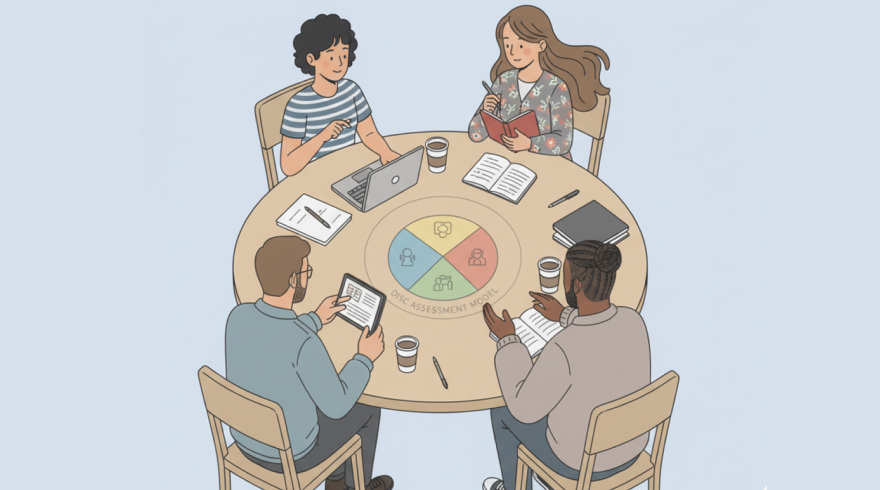
To make those patterns tangible, many practitioners plot results on the DISC assessment wheel so participants can see adjacency, contrast, and likely collaboration friction in one glance. That single image helps individuals understand why some conversations feel effortless while others demand intentional adjustments, and it also helps managers anticipate handoff risks on cross-functional work.
Below is a concise matrix you can scan during planning sessions, one-on-ones, or retrospectives to translate theory into action without memorizing jargon.
| Style | Core Drive | Typical Strength | Watch-Out | Try This |
|---|---|---|---|---|
| Dominance | Results and speed | Decisive execution | Impatience under delays | Agree on success metrics and timelines |
| Influence | Connection and enthusiasm | Inspiring communication | Over-optimism in estimates | Confirm commitments in writing |
| Steadiness | Harmony and support | Reliable collaboration | Reluctance to abrupt change | Provide advance notice and rationale |
| Conscientiousness | Accuracy and logic | Quality standards | Analysis paralysis | Clarify constraints and decision criteria |
The matrix is not a verdict but a playbook, encouraging people to flex appropriately. Over time, teams internalize these cues and naturally adjust tone, structure, and pacing to suit the situation and the stakeholder, which reduces rework and accelerates throughput.
- Use quick “style scans” before critical meetings.
- Design agendas with both DISCussion and documentation.
- Balance urgency with diligence by pairing complementary strengths.
Personal Growth: Self-Awareness, Communication, and Career Clarity
Professionals who invest in behavioral literacy gain sharper self-awareness and a more nuanced grasp of others. That translates into better boundaries, more intentional routines, and smarter choices about roles that fit their energy. Clarity at this level eliminates a lot of trial-and-error career moves because you can evaluate opportunities through the lens of pace, autonomy, collaboration, and precision.
For many, a thoughtfully debriefed DISC personality assessment becomes an inflection point that reframes strengths as strategic assets rather than quirks to hide. The conversation shifts from “fix what’s wrong” to “deploy what works,” while still addressing blind spots with concrete micro-habits and situational strategies that are easy to practice daily.
Communication improves quickly when individuals learn to modulate language, ask better questions, and check for meaning instead of assuming agreement. Conflict also becomes less personal because disagreements can be traced to different needs for data, time, influence, or autonomy. Over weeks, this reduces emotional tax and preserves momentum even under pressure.
- Build routines that honor your natural work cadence.
- Translate strengths into artifacts like checklists or templates.
- Choose mentors whose styles complement your gaps.
Ultimately, personal mastery shows up as consistency: fewer derailments, more resilient focus, and a reputation for adapting without losing your edge.
Team Dynamics and Organizational Impact
When a group embraces shared behavioral language, collaboration gets lighter and throughput increases. Meetings are designed for both talkers and thinkers, project plans balance speed and quality, and decision rights are clearer. Leaders stop micromanaging because they can now orchestrate talent based on predictable strengths rather than guesswork, which unlocks DISCretionary effort across the board.
Within HR and operations, a calibrated DISC workplace assessment helps align hiring profiles, onboarding plans, and role expectations so employees ramp faster and stay engaged longer. The same insights inform customer-facing playbooks, enabling teams to adjust DISCovery, demos, and support interactions to suit different buyer preferences and contexts.
Results compound when teams operationalize behavior-aware workflows. Consider how handoffs improve when contributors document assumptions in ways that match the receiver’s information style. Think about retrospectives that diagnose friction without blame because the conversation is framed around needs and trade-offs, not personalities.
- Codify collaboration norms for pace, detail, and feedback.
- Map critical roles to style blends that fit the work.
- Instrument pipelines with checkpoints suited to each stakeholder’s comfort zone.
Over time, this vocabulary becomes cultural infrastructure, stabilizing performance even as the organization scales and complexity rises.
Developing Managers and Executives
Effective leadership isn’t one-size-fits-all; it’s situational, adaptive, and deeply attuned to people’s drivers. Executives who internalize behavioral frameworks coach more precisely, set context more clearly, and calibrate stretch assignments to motivate without burning people out. They also reduce unforced errors by anticipating where they themselves may overuse strengths under pressure.
Many organizations deploy a targeted DISC leadership assessment to illuminate how a manager’s default style affects strategy execution, stakeholder influence, and team climate. The findings help leaders architect rituals, like decision logs, office hours, and cadence agreements, that create clarity and autonomy simultaneously, which is the hallmark of a healthy system.
Beyond introspection, leadership development must translate into repeatable practices. That includes building communication frameworks for high-stakes conversations, designing cross-style feedback protocols, and creating escalation paths that protect relationships while accelerating choices. When leaders model this agility, it cascades throughout the org chart.
- Coach to context: task complexity, time horizon, and risk tolerance.
- Pair complementary deputies to counterbalance your blind spots.
- Use pre-mortems to surface style-related failure modes before they occur.
The result is steadier execution and a team that feels both understood and accountable, which drives retention and results.
How to Take the Instrument: Formats, Timing, and Debriefs
Most vendors deliver a modern, mobile-friendly questionnaire that takes minutes to complete and yields a clear, visual report. The best experiences include a guided debrief that converts charts into actionable commitments and working agreements with teammates. Without that step, insights remain interesting but underutilized.
If you prefer a quick entry point, you might choose a streamlined DISC assessment test that balances brevity with validity for a fast pulse on behavioral tendencies. Debrief notes should then translate tendencies into practical experiments you can run in meetings, email threads, and planning sessions to verify fit.
Some providers emphasize trait language that resembles typical psychometric screenings, while others focus on situational behavior that translates immediately to workflow. In either case, accuracy improves when participants answer based on recent, real scenarios rather than abstract ideals or aspirational personas.
For respondents who want richer narrative context, an extended DISC assessment personality test can provide deeper explanations, stress responses, and conflict patterns to inform coaching plans. These longer forms are especially useful for role transitions, reorganizations, or new leader assimilation when stakes are high.
Teams engaged in onboarding or succession planning often benefit from a comprehensive DISC profile assessment that includes comparison overlays across teammates and stakeholders for day-one collaboration agreements. The goal is not more data but better decisions about handoffs, meeting design, and communication norms that reduce friction.
- Schedule debriefs within a week to keep insights fresh.
- Capture two new habits to test for 30 days.
- Revisit results after key projects to calibrate growth.
Free Vs. Paid Options, Choosing Providers, and Selecting the Right Toolkit
Choosing between entry-level resources and enterprise-grade platforms depends on purpose, audience size, and the need for integration or analytics. Internal champions should clarify whether they need light-touch awareness, structured development journeys, or embedded workflows that connect to HRIS and performance tools.
For individuals curious about the topic, a limited-scope DISC assessment free option can offer an accessible starting point with enough detail to spark self-reflection and basic communication tweaks. As soon as teams want scalability, however, the requirements shift toward reliability, security, and consistent debrief experiences.
Small groups sometimes begin with a simple screening from a provider that offers a DISC assessment online free pathway for pilots or workshops. This lets facilitators test adoption, collect feedback, and decide whether a more robust implementation with coaching and team mapping is justified by outcomes.
Organizations that standardize on this framework usually evaluate reporting depth, administrator controls, integrations, and support for comparative maps across departments. They also explore facilitator training and certification for internal enablement, ensuring quality and consistency as usage grows.
When comparing vendors, decision makers look at data quality, security posture, and breadth of DISC assessment tools that transform reports into day-to-day practices like meeting templates, role scorecards, and collaboration agreements. The right toolkit makes the methodology durable, useful, and measurable across quarters, not just during kickoff week.
- Define success metrics before rollout to prove value.
- Pilot with cross-functional teams to stress-test workflows.
- Document norms and embed them into onboarding and reviews.
FAQ: Common Questions Answered
What does this model actually measure?
It focuses on behavioral preferences, how people tend to approach problems, pace, social interaction, and rules, rather than fixed personality traits. Results reflect observable patterns that can flex with context, giving teams a practical vocabulary for designing communication and collaboration. This is why it works well in environments where speed, clarity, and alignment are critical to execution and morale.
Can results change over time?
Fundamental preferences are relatively stable, but intensity and expression can shift with role changes, stress levels, and deliberate practice. People often show different emphases at work versus home, or during high-stakes projects versus routine execution. Periodic refreshes help recalibrate strategies and keep development plans relevant to current realities and objectives.
Is it appropriate for hiring?
It can inform structured interviews and onboarding, but it should never be used as a pass/fail gate. Ethical usage focuses on job requirements, validated competencies, and evidence-based evaluations, with behavioral insights serving as a supplementary lens. This approach avoids bias, protects candidate experience, and strengthens role fit through transparent expectations and support.
How long does it take and what about accuracy?
Most questionnaires take 10–20 minutes, with immediate, visually intuitive reports. Accuracy improves when respondents answer based on recent behavior rather than ideals, and when a trained facilitator provides context that prevents overgeneralization. Follow-up coaching sessions convert insights into specific habits that make measurable differences in meetings and deliverables.
What distinguishes this from other behavioral tools?
It offers a simple, memorable language combined with high utility in day-to-day collaboration, which accelerates adoption across roles and levels. Many teams also appreciate how the framework supports shared norms without pathologizing differences, keeping the focus on outcomes and agreements. That clarity is why practitioners frequently recommend a guided exploration of DISC assessment before layering in additional methodologies for specialized needs.